The Long Review: Disgrace by J.M. Coetzee
This 1999 Booker Prize Winner masterfully interrogates the ghost in the machine: the frail and flawed humans who must survive the engines of societal change.

(not really, it’s pretty amazing).
I’ve struggled with this review more than any other I’ve written. Probably that’s because I know (a) my take is probably far from the author’s intentions and (b) it will condemn me as an apologist and assign me to the same circle of hell as the book’s protagonist, David Lurie. The saving grace is that no one reads what I write anyway.
I’ll start with my usual sorry-not-sorry caveat about reviewing. My understanding of literary criticism, and literary movements, is rudimentary. That’s particularly pertinent here, because J.M. Coetzee is a colossus in post-colonialism. Even I know that you can’t walk a step on an undergraduate literature course before banging your noggin on that. None of this, of course, is going to stop me talking out of my arse about this important work.
Your mildest spoiler, please.
This isn’t a book I can discuss without some mild spoilers, but I will try to minimise them. The back of the Penguin edition of Disgrace tells us:
After years of teaching Romantic poetry at the Technical University of Cape Town, David Lurie has an impulsive affair with a student [Melanie]. The affair sours; he is denounced and summoned before a committee of inquiry. Willing to admit his guilt, but refusing to yield to pressure to repent publicly, he resigns and retreats to his laughter Lucy’s isolated smallholding… He and Lucy become victims of a savage and disturbing attack which brings into relief the faultlines in their relationship.
To this, I’ll add that the time period is post-Apartheid and the attack includes Lucy’s rape by three black men.
Masterwork, but not hard work
Let’s start with a quick word on Coetzee’s writing style in Disgrace. I’d characterise it as efficient and disciplined. His prose has a job to do, and that is to allow access to his numerous great big themes. I don’t mean that it’s dull or utilitarian. It’s more that his writing doesn’t impose itself upon you; it’s content to be immediate and readable. Here’s a quick taste:
The old tone has entered; the tone of the last years of their married life: passionate recrimination. Even Rosalind must be aware of that. Yet perhaps she has a point. Perhaps it is the right of the young to be protected from the sight of their elders in the throes of passion. That is what whores are for all, after all: to put up with the ecstasies of the unlovely.
I’d dog-eared that page for the phrase ‘ecstasies of the unlovely’. Isn’t that fab? It sounds like an album title. One of Coetzee’s sparing but masterful flourishes.
And here’s what I mean by efficiency.
He has not taken to Bev Shaw, a dumpy, bustling little woman with black freckles, close-cropped wiry hair, and no neck. He does not like women who make no effort to be attractive.
In just a few words, he’s given me a mental image of Bev Shaw, an insight into David, and what defines their current relationship.
That tautness and discipline extends into the storytelling: everything is told through David’s eyes. That probably makes it tougher going for readers who find our man grotesque. More on that in a bit.
The ghost in the historical machine.

than me. And he is.
By Laterthanyouthink – Own work,
CC BY-SA 4.0, Link>
I suppose one thing that sets a great writer apart is the ability to show how characters are affected by the larger social currents around them. With apologies for being fancypants about it, a great work can juxtapose the eternals of the human condition – the need for love, dignity, recognition, for example – with the context of time and place.
I guess that’s the essence of Disgrace. Protagonist David finds himself in a post sexual revolution era, where the seeds of #metoo are already starting to sprout. He’s also a white guy in post-Apartheid South Africa. Yet he’s also a human with the same needs everyone has. For me, what drives the narrative is how his inner experience collides with these big social movements.
Pick your theme.
When it comes to themes, Disgrace is a Quality Street novel: there’s something for just about everyone. I can only focus on what I spotted and what interests me.
Post-colonial themes do interest me, but I don’t feel I can say too much about them. The whole thing is too far outside of my experience, and I sense I’m missing important stuff right, left and centre.
Instead I’ll have a bash at what I saw as another theme: symmetries within the work.
It seems to me that Disgrace is shot through with symmetries between the country and the urban parts of the novel, between David’s academia-based life and his (and Lucy’s) rural life.
Firstly, there’s the way a hatred of systemic injustice gets focused onto convenient though imperfect symbols. White woman Lucy is a symbol of centuries of injustice and oppression against the black population, and that translates into a savage attack and rape. She and David note the boiling, personal hatred this involves. But Lucy hardly fits the image of a white oppressor: she is trying to reach an accommodation with the black people whose land the whites had usurped.
Likewise, David is a symbol of the male patriarchy, harangued with real venom as an exploiter and abuser. Yet is abuser the right description? He’s not Jeffrey Epstein. Melanie is young, but she is an adult. Lurie does not take advantage of Melanie at her most vulnerable. And at one stage Melanie willingly comes to him. So, David certainly has some hard questions to answer, but is he the straightforward predator that his furious denouncers demand? In both cases, it seems that even if you’re not be the perfect symbol of an injustice, but when the hate starts rising, you will do just fine. Your mitigations won’t help you escape the fury.
Perhaps we also see this urban-rural symmetry with ‘male egocentrism’. That’s not the perfect description, but the closest I can get. Here’s what I mean: David is a devotee of Lord Byron, who declared that he would ‘rather die than see a passion unfulfilled’. That’s a watchword for David’s sexual life, as he pursues any woman that takes his fancy. He applies this to Melanie: he sees her, he wants her, and he gives little thought to the consequences. His Byronic ideals give him license to do what he wants. In the rural setting, we see the logical endpoint of this need to see passion fulfilled (passion for power, passion for revenge) in Lucy’s rape. It is an expression of profound male egocentrism. Maybe it is David’s Byronic impulse with the brakes taken off and the literary traditions stripped away?
David Lurie: get those prejudices ready.
I can’t join in with the howls of condemnation I can hear from, say, Goodreads
Now comes the tough part. The prejudices engendered by my age, upbringing, values, personal history, education and personality quirks all conspire to help me – at the least – understand David Lurie. I can’t join in with the howls of condemnation I can hear from, say, Goodreads.
Here are a few reasons why I can’t find him completely despicable.
- For a symbol of arrogance, he’s surprisingly humble. He knows he’s not an inspiring teacher. He acknowledges that his opera won’t be a success, or of interest to anyone. He admits that he struggles at being a parent.
- David’s strongest love is for his daughter. His most consistent and selfless desire is to protect her. He tries hard to navigate, not always successfully, her need for autonomy. He sees this as leading to self-destructive decisions – and he may be right.
- Despite having little natural empathy for animals, he takes the job of disposing of their bodies, because it seems the right thing to do, even though it means nothing to the animals, or to any other humans.
- He seems to have fewer social prejudices than most: he doesn’t seem to extend his hatred of the rapists to other black or tribal people. It’s true that he ranks his sexual partners in terms of their physical attractiveness, but if that is a sin, it’s about as common as it gets.
But the reasons I’m even looking for positives is because of the following .
First and foremost, one of my peculiarities is that I can never abide public shaming. That moment when the press are crowding in, the catcalls and ‘what do you say to the victims?’ To me, it just feels the moment when the hounds close in on the fox. I think it triggers a bloodlust, a pack response, that’s buried deep down in our DNA. And yet weirdly, it’s not in mine. No matter who is on the receiving end, I find it sickening. The moment this happens in Disgrace, I immediately empathise with Lurie for the rest of the book.
Secondly, I understand the alienation of ageing. There’s a long, boring bit about this lower down.
Thirdly, it’s because – as Coetzee makes clear – condemnation of his relationship with Melanie is partly based on disgust, rather than ethics. There are sensible reasons to proscribe sexual relationships between lecturers and students. They prevent exploitation of one party by the other; they reduce potential compromise of academic standards. But a good deal of the disgrace David faces is absolutely nothing to do with that. Instead, it’s a disgust with two parties of such different ages sleeping together. The lecturer-student dynamic certainly exacerbates that disgust, but it would still have been there without it. By the way, if you want to read a brilliant take on a May-December romance, I recommend Julian Barnes’s The Only Story. And if you want to read an admittedly-less-brilliant-than-Barnes’s-but-also-funnier take on my own May-December relationship, buy my ‘Best Nuisance‘ book (see end of page).
The point is that it’s a forbidden love, an unnatural one: every era has its own. And while I can condemn him on the lecturer-student front, personally I’ve been on the receiving end of age-difference relationship prejudice, and it’s not nice .
I am certain that most readers would be happy to tell me that my white-older-male prejudices make me filter out Lurie’s sins. That’s undoubtedly true. But an interesting question is whether the same filtering applies to readers who straightforwardly despise Lurie.
To illustrate, here’s something Google’s AI supplied when I was trying to find a quote from the book (I hadn’t even asked a specific question, Google AI just jumped in with its clodhopping feet):
David uses this “Byronic” logic to dignify his predatory affair with his student, Melanie. He tries to frame a sordid abuse of power as something noble, elemental, and fatalistic.
Isn’t that interesting? Because calling it a ‘sordid abuse of power’ is itself is a framing, isn’t it? It’s a framing drawn by AI from Sparknotes, Reddit discussions, critics, all in turn informed by the mainstream, culturally proscribed values of the day.
As I noted above, defining their relationship as predatory requires some filtering of nuance. To me, ‘predatory’ implies deliberately targeting the most vulnerable. But has Lurie selected Melanie specifically because of her vulnerability, her inability to refuse? Or rather, as seen elsewhere in the book, is he in the habit of trying it on with anyone who he fancies? And is Melanie to be denied any agency in her own sexual choices?
My point is that David Lurie is a projection screen for our own values. And perhaps one point of the novel is that every other person round us is both a projection screen for our own prejudices, positive and negative, and simultaneously a living, breathing, feeling, thinking human being, struggling to make their way through the world.
The alienation of ageing
I’m in two minds about including this section because it’s too long and it’s only going to come off as a windbag’s apologism for David Lurie. So be it. I really dislike the words ‘apology’ and ‘apologists’, by the way, regardless of context. It’s just a lazy shorthand for saying that your case is already proven, and whatever the other person say can’t have any merit. I much prefer it in its original context: the early Christian Apologists were people who explained the tenets of Chrisitanity, not said sorry for them.
Each generation has no doubt that their own value system is the culmination of all that is right, whereas those of previous generation were either ludicrously priggish or debauched.
When this book is discussed in literature classes, my guess is that – generally speaking – the theme of loneliness and alienation in ageing doesn’t get much bandwidth. I have no evidence for this, but I reckon that in the headlong rush to tackle themes of sexual power and colonialism, those more personal themes get trampled underfoot. Besides, that might look dangerously close to sympathy (see above).
But for me, at my age, the creeping alienation that comes with getting old is a powerful theme. It’s expressed in his response to a changing culture:
He has long since ceased to be surprised by the range of ignorance of his students. Post-Christian, posthistorical, postliterate, they might as well have been hatched from eggs yesterday. So he does not expect them to know about fallen angels or where Byron might have read of them.
Ah God, I know that feeling. How you start with incredulity that the young don’t share what you regard as basic, the most basic, cultural reference points. Then despair, as you realise this isn’t just an anomaly, it’s widespread. Then weary resignation.
More often, though, we see it through Lurie’s realisation that he, a sexual being, is gradually becoming invisible to women. He is being assigned to a class that is not anticipated to have sexual feelings, and certainly not towards someone much younger than himself. If he must have them, he is to stay in his lane:
Ryan draws on his cigarette. “Only doing you a favour, man. Didn’t you learn your lesson?”
“What was my lesson?”
“Stay with your own kind.”
Even the names given to sexual longing must now be redesignated:
An unseemly business, sitting in the dark, spying on a girl (unbidden, the word letching comes to him). Yet the old men whose company he seems to be on the point of joining, the tramps and drifters with their stained raincoats and cracked false teeth and hairy earholes – all of them were once children of God, with straight limbs and clear eyes.
But I think that deeper than both of these, Lurie is subject to an alienation of moral values. This will take a bit of explaining, so bear with me.
Think of it this way: when you were young, let’s say before the age of twnty, you were busy soaking up the moral systems of the day. You learned what was funny and what you could tell jokes about. You learned how you should speak to various types of people: parents, peers, people of different sexualities or ethnicities, authority figures, and how you should think of them. You learned the rules of sexual interaction: what was fair, and what wasn’t; what was expected in attraction and being attracted, beginning and ending sexual relationships; appropriate sexual partners. And of course, those values may be adapted through life, but before twenty is when your developing brain was steeped in them from dawn to dusk.
Now consider how each generation thinks its moral system is absolute and unchallengeable, as if it rises from the earth itself. Sex and gender roles are relevant examples. For much of British history, it was absolutely obvious that a woman was her husband’s property. For mediaeval peasants, it was absolutely obvious that parents could have sex while children were present in the same room. For Victorians, it was absolutely obvious that male homosexuality was a serious crime against man and God. Each generation has no doubt that their own value system is the culmination of all that is right, whereas those of previous generation were either ludicrously priggish or debauched.
So what happens when value systems change radically between generations? The young have experienced no alternative to their system and can only respond with outrage and disgust when confronted by something outside of it. Ah, but for the previous generations: everything that they believed was true and good, that their parents and teachers and culture taught them was proper and right, is now false and evil. Not for everyone, of course. People adapt to cultural shifts at different speeds. For those who cleave to what they were brought up with, who remain steadfast against change: can there be any more profound alienation? What does it mean to live in a society that rejects what you hold to be self-evident?
Here’s one example. In my parents’ generation, at least in the working classes, it was a given that young women were romantically pursued and that men did the pursuing. The roles were clearly delineated, and both genders understood these rules. A woman had to be wooed until she ‘gave in’. A man might have to do an extensive amount of wooing, and break down her initial resistance. A woman must never give in to wooing too soon. Only a slut would do that. Today, obviously, a different set of rules operate. Pursuing a woman who isn’t reciprocating isn’t wooing, it’s harassment and stalking. It’s viewed as the precursor to sexual and violent crimes. It’s certainly nothing to which one should aspire.
I’m not saying ‘things were better before we went all xyz’ at all. I’m saying that if you view that behaviour as harassment and stalking, you’re unlikely to ever step outside of that assessment. If you were brought up in the days of wooing, you might be forced to, but it may well be a troubled shift.
Circling back to our protagonist: Lurie is an expert on romantic poetry, full of wooing and conquests. He’s part of a generation that was caught between two stools. On the one hand, they were at the tail-end of the ‘women have to be pursued’. On the other, they were influenced by post-war existentialism (everyone is responsible for their own actions, so ignore power structures) and the sexual revolution (women have sexual autonomy). Put these together and suddenly Lurie is spectacularly ill-equipped to deal with notions of sexual exploitation… at least between consenting adults. He’s smart enough to understand the idea, but that’s not the same as feeling it.
Will you be an irrelevant curmudgeon, trapped in your ways, reviled and disgraced by your successors?
In summary, the world is on Sexual Ethics Version 71,289 and David’s been programmed on Version 71, 288. What a position for anyone to find himself , or herself, in!
Now, you may never find yourselves at odds with current society over sexual ethics, but chances are you will be at odds over something. Chances are, you will experience increasing alienation from the generations below you and the world they inhabit. What will your response be? Will you be an irrelevant curmudgeon, calcified by your upbringing, reviled and disgraced by your successors? Or will you uncritically acept that each iteration of societal values must be better than the last, then limp along like the old wildebeeste trying to keep up with the herd? Neither option seems very palatable. Maybe that’s why I found Disgrace an excellent but sobering and saddening read.
And on that less optimistic note, let’s get to the summary already.
The Verdict
Hey, don’t neglect this classic.
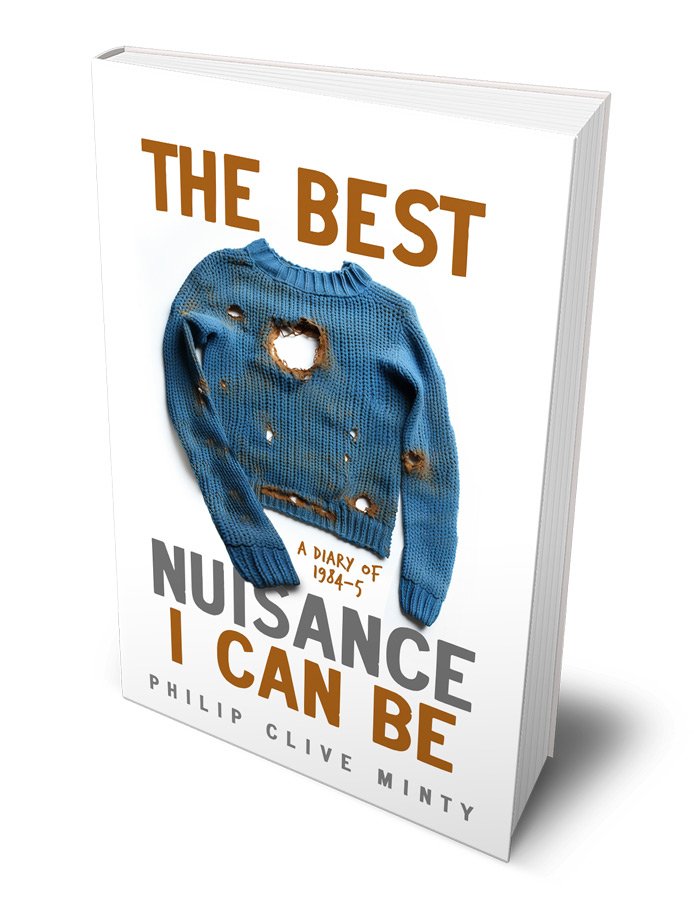
OK, calling it a classic might be a bit premature. But I reckon that my book is a pretty good read – for the right sort of person!
The Best Nuisance I Can Be is a novelisation of my real 1984-85 college diaries. It covers my tumultuous final year as an undergraduate at an English university, a period that delivered friendship, love, oodles of fun and some horrible self-discoveries.